

“Most assets on exchanges are cold-stored” is true but incomplete — OKX keeps over 95% of customer funds in air-gapped, multi‑signature cold wallets, yet the practical security picture for a US trader depends on more than that single fact. This article cuts through three common misconceptions about OKX (spot vs. futures, custody vs. self-custody, and the safety of login flows) and gives concrete, mechanism-level guidance for traders who need to log into an OKX account and trade intelligently in a US regulatory and technological context.
Startling opening claim: delisting is routine, not catastrophic — but it matters for strategy. In March 2026 OKX removed several spot pairs (RSS3, MemeFi, GHST, RIO, SWEAT). That’s normal housekeeping to trim low‑liquidity listings, and it illustrates an important trade-off: exchanges delist to preserve market integrity, but delistings impose real operational costs on traders holding niche tokens. Read on for a short mental model that turns these facts into a practical checklist.
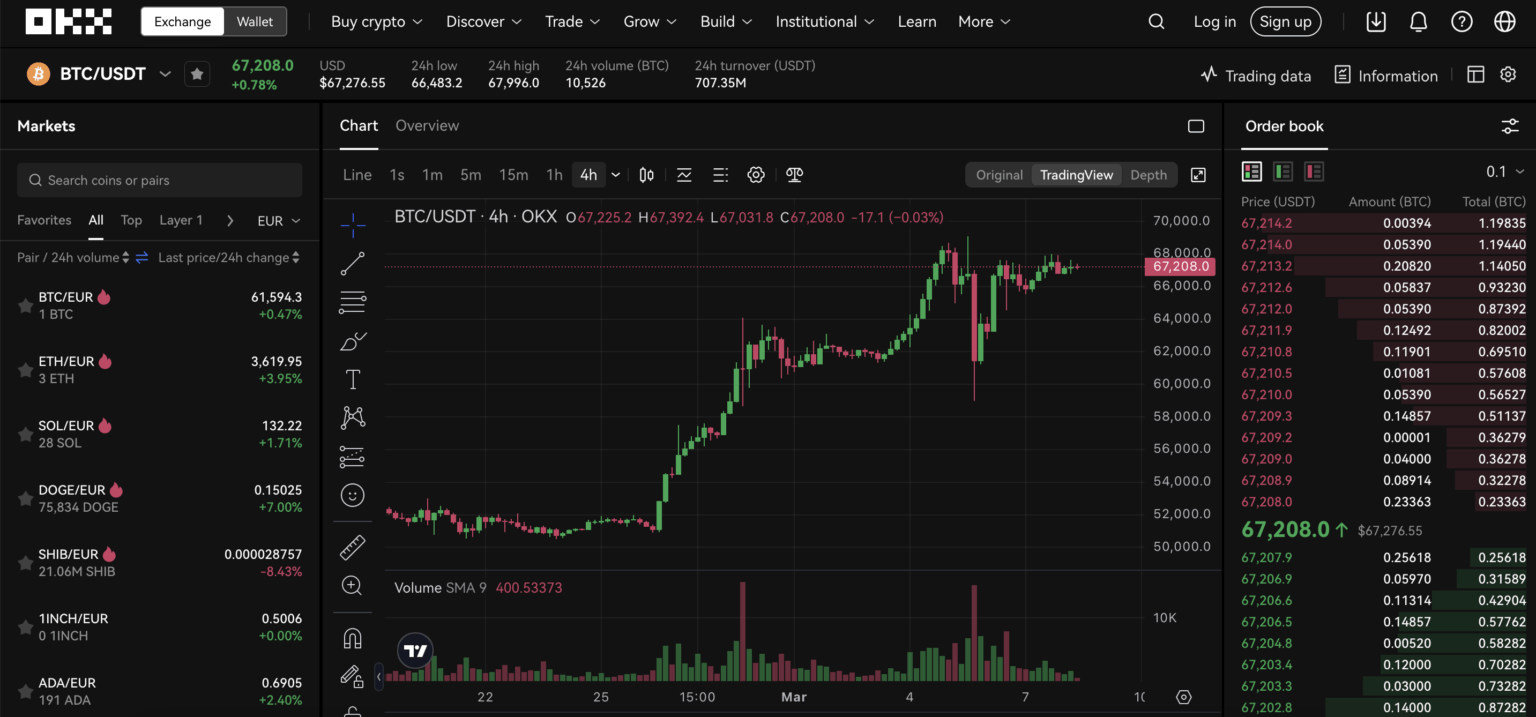
Myth 1 — “Spot trading on OKX is safe because the exchange stores assets in cold wallets”
Reality: cold storage reduces custodial theft risk, but it doesn’t eliminate user-facing attack vectors. Mechanism: cold wallets keep keys offline and require multiple approvals to move funds; this reduces the chance a single hacker or compromised server can drain reserves. Limitation: cold storage protects assets held by the exchange, not assets outside it (for instance in your non‑custodial wallet), and it doesn’t stop phishing attacks that trick a user into revealing a password or 2FA code.
Decision-useful takeaway: treat custody layers differently. When you log into OKX, bifurcate decisions: use the CEX for active trading where low latency and deep liquidity matter; use your OKX non‑custodial Web3 wallet or hardware wallet integrations (Ledger/Trezor) for long-term holdings where you control the seed phrase. Rely on Proof of Reserves as a transparency signal — it shows on‑chain backing — but combine that with procedural safeguards: strong 2FA, staggered withdrawal whitelists, and small test transfers when moving unfamiliar tokens.
Myth 2 — “Futures are just leveraged spot trades; complexity is the only risk”
Reality: futures and perpetuals are structurally different instruments, with separate margining, funding, and liquidation mechanics. Mechanism: spot trading settles you at market price — you own the asset. Futures are contracts; perpetual swaps use funding rates to tether contract price to spot. OKX offers up to 125x leverage on some derivatives, while margin on spot uses up to 10x. That delta matters: liquidation dynamics accelerate non‑linear losses, and funding payments can erode carry strategies over time.
Why it matters in practice: if your plan is directional exposure without the operational burden of custody (and without taking out debt), a spot trade plus staking or yield is different from a futures position that creates recurring P&L drains via funding or margin calls. Heuristic: for retail traders in the US, use leverage sparingly; treat isolated margin as a circuit-breaker compared with cross‑margin. Isolated margin limits spillover from one losing position, which is a tactical advantage when markets are choppy.
Myth 3 — “Logging in is a checkbox: enable 2FA and you’re done”
Reality: login security is a layered system where institutional-grade features (AI-driven threat detection, military‑grade encryption) reduce risk, but human factors and external tools create vulnerabilities. Mechanism: OKX requires KYC, which ties identities to accounts and makes account recovery different in the US context; it also uses AI to flag suspicious logins, and mandates 2FA (SMS, authenticator apps, biometrics). Each method has trade-offs: SMS is convenient but phishable/SIM‑swap prone; Google Authenticator is stronger but less convenient across devices; biometrics are excellent for mobile but can complicate hardware wallet flows.
Practical login playbook: 1) register and complete KYC during a calm, private session; 2) enable an authenticator app (not SMS) and save backup codes offline; 3) link a hardware wallet for non‑custodial holdings; 4) use IP/device whitelisting where available; 5) if you suspect a phishing page, do not enter credentials — instead visit the exchange via a bookmarked safe URL or a trusted resource such as https://sites.google.com/cryptowalletextensionus.com/okx-login-web/ that documents secure login practices and official entry points.
How OKX’s product mix changes what you trade and how
Because OKX combines CEX services, a non‑custodial wallet, an NFT marketplace, and a DEX aggregator, traders can cross workflows that were previously separate. Mechanism and trade-offs: the DEX aggregator can find cheaper on‑chain swap routes for certain tokens, but doing so means interacting with smart contracts (counterparty risk, possible approval of token allowances). NFTs and staking provide yield and collectible exposure but bring different liquidity profiles and smart‑contract risks than spot BTC/ETH trades. For a US-based trader, regulatory compliance via KYC adds friction but also benefits: fiat rails, debit/ACH onramps, and clearer dispute resolution paths.
Non‑obvious insight: using the ecosystem effectively is about mapping time-horizon to custody. Short-term scalps and high-frequency futures belong in the CEX arena. Medium-term positions that you still want to earn yield on can stay on exchange under PoR transparency; long-term “cold” bets should live in your self‑custodial wallet or a hardware wallet.
Where this framework breaks — limitations and unresolved issues
Three boundary conditions to keep in mind. First, Proof of Reserves is a transparency tool but has limits: PoR demonstrates backing at a point in time and by on‑chain balances, yet it doesn’t directly show operational controls or insurance scope. Second, delistings (like the recent March 2026 trimming) show that exchanges balance liquidity and legal risk; holding low‑volume tokens on exchange raises the chance you’ll be forced to convert at unfavorable times. Third, interacting with DeFi through OKX’s wallet exposes you to smart contract risk and composability hazards that are difficult to quantify for most retail traders.
These are not theoretical caveats; they determine real outcomes. For example, if a token you hold becomes illiquid and is delisted, your exercise options shrink and you may incur slippage selling via a DEX. Conversely, heavy use of futures in a volatile regime can produce cascading liquidations across accounts that share cross‑margin pools.
Decision heuristics — a quick checklist before you trade on OKX
– Purpose: decide whether you want custody (control seed) or convenience (CEX liquidity).
– Time horizon: use spot/staking for longer holds, futures for tactical directional bets with strict risk limits.
– Login hygiene: prefer authenticator apps or biometrics, keep backup codes offline, use hardware wallets for large balances, and whitelist withdrawal addresses when possible.
– Liquidity check: before buying a small‑cap token, scan order book depth and recent volume; if thin, accept possible wide spreads or avoid the asset.
– Regulatory comfort: KYC is required; factor identity processes and their timing into your trade planning, especially for large deposits or withdrawals in USD.
FAQ
Can I use OKX in the US and still use all features?
Yes, US users can create accounts and access spot, futures, wallet, and staking features, but availability of specific products or tokens can vary by jurisdiction and KYC outcome. Expect some listings or high‑leverage derivatives to be restricted depending on regulatory considerations. Always check the product eligibility in your account dashboard before planning a trade.
Is Proof of Reserves a guarantee I won’t lose money if the exchange fails?
No. Proof of Reserves shows that on‑chain balances back deposits at snapshot times; it isn’t a guarantee of operational continuity, insurance against price moves, or protection from off‑chain liabilities. It is a strong transparency signal but should be paired with prudent personal risk management.
How should I decide between margin on spot and opening a futures position?
Use a futures contract when you want pure exposure without moving the underlying asset and are comfortable with funding costs and liquidation mechanics. Use spot margin when you want leverage but prefer to hold the asset itself and possibly earn staking/yield. Prefer isolated margin to constrain loss to a single position in volatile markets.
What should I watch next as signals that affect trading on OKX?
Monitor delisting notices (they indicate tightening listing standards), funding rate trends on perpetuals (they affect carry costs), and PoR publication cadence. Also watch regulatory announcements in the US that could restrict certain derivatives or token listings; those signals materially change product availability and market liquidity.